

Form
A climbing stem produces successive elongated heart-shaped blades and develops a clean vertical line.
This store requires javascript to be enabled for some features to work correctly.
Variegation that shouts ‘I'm collectable’ 📣
Family: Araceae · Pot diameter: 12 cm · Height: 30–35 cm
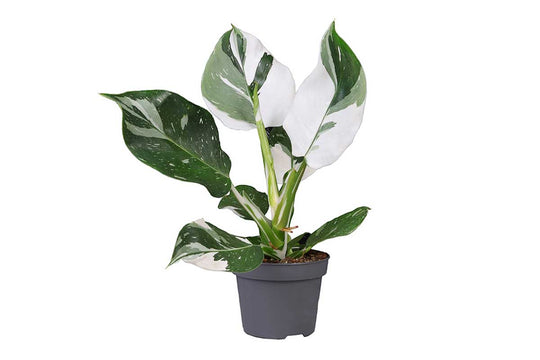
Philodendron erubescens ‘Pink Princess’ has become an icon of collectable plants through its unpredictable mix of deep green, near-black burgundy and clean pink. One leaf carries small strokes, another marbled clouds and another large sectors, making the crown feel like a living series of unique artworks. Beside shelving or in a bright corner, it creates a luxurious vertical presence and instantly becomes the room's conversation piece.
The dark background makes pink appear even cleaner, while burgundy petioles visually unite the different patterns. Every new leaf adds suspense and progression to a collection, so its appeal lies not in perfect symmetry but in uniqueness and dramatic contrast built over time.
Variegation distributes pink unpredictably across exceptionally dark foliage.
A climbing stem produces successive elongated heart-shaped blades and develops a clean vertical line.
Deep green, burgundy and pink form flecks, marbling or broad sectors with no two leaves alike.
A smooth glossy surface strengthens contrast while burgundy petioles add warm structure.
Why you’ll love it: it turns every new leaf into a unique event, pairing iconic pink with a dramatically dark background.
Near a bright window with a slim support or moss pole so the nodes can climb and the leaves can mature. Leave breathing room around the crown so each leaf shape reads clearly.
Choices with compatible light needs and contrasting textures keep the arrangement balanced.
Bright, indirect light. Variegated forms need steady light without harsh sun.
When the top 2–4 cm are dry. Water thoroughly and let all excess drain away.
Moderate to higher humidity and roughly 18–29°C, away from cold or hot draughts.
Not safe to chew. It contains insoluble calcium oxalate crystals.
Keep it near an east-facing or bright north-facing window, or behind a sheer curtain. Low light reduces leaf size and variegation, while harsh sun can scorch pale tissue.
Check the mix before every watering and wait until the top 2–4 cm are dry. Water evenly, let it drain and never leave water standing in the cover pot.
It adapts to average household humidity, but steady humidity and gentle air movement support cleaner edges and smoother unfurling.
An ideal range is roughly 18–29°C. Avoid cold glass, air-conditioner draughts and sudden changes that slow growth.
Use an airy aroid mix with ample pore space around the roots and moderate moisture retention. Unrestricted drainage is essential.
During active growth, use a balanced liquid feed at the label rate and only on already moist substrate. Repot when roots fill the pot, moving up by one size.
‘Pink Princess’ is a cultivated variety botanically associated with Philodendron erubescens.
The wild species P. erubescens is an aroid from tropical South America, while pink variegation belongs to the cultivated selection.
The cultivar is maintained clonally so the mosaic trait is carried forward, without guaranteeing the same pink distribution on every leaf.
From natural habitat to care: The species' climbing origin explains why steady upward growth organises the stem and gradually supports larger blades.
In some zones green chlorophyll is reduced and pink to red tissue pigments become visible.
Different cell lines coexist in the growth point, so colour proportion changes in every new leaf.
With less chlorophyll, extensive pale sectors depend on the plant's green portions.
Insoluble calcium oxalate crystals strongly irritate the mouth and digestive tract if chewed.
Practical answers about growth and the plant’s most common signals.
Not precisely. The pattern depends on cells in the active growth point and can change greatly even between successive leaves.
One old lower leaf may age normally. Several at once call for checks of moisture, drainage, light and root condition before adding water.
Climbing stems benefit from slim firm support, while trailing growth tends to retain smaller leaves. Secure only the stem and leave petioles free.
An abrupt humidity change, dry roots or cold can hinder unfurling. Stabilise conditions and never pull the soft blade.
Cut a healthy stem section with at least one node and an active growth point. A single leaf without a node cannot produce a new plant.
Not for chewing or ingestion. Insoluble calcium oxalate raphides can cause marked oral irritation.