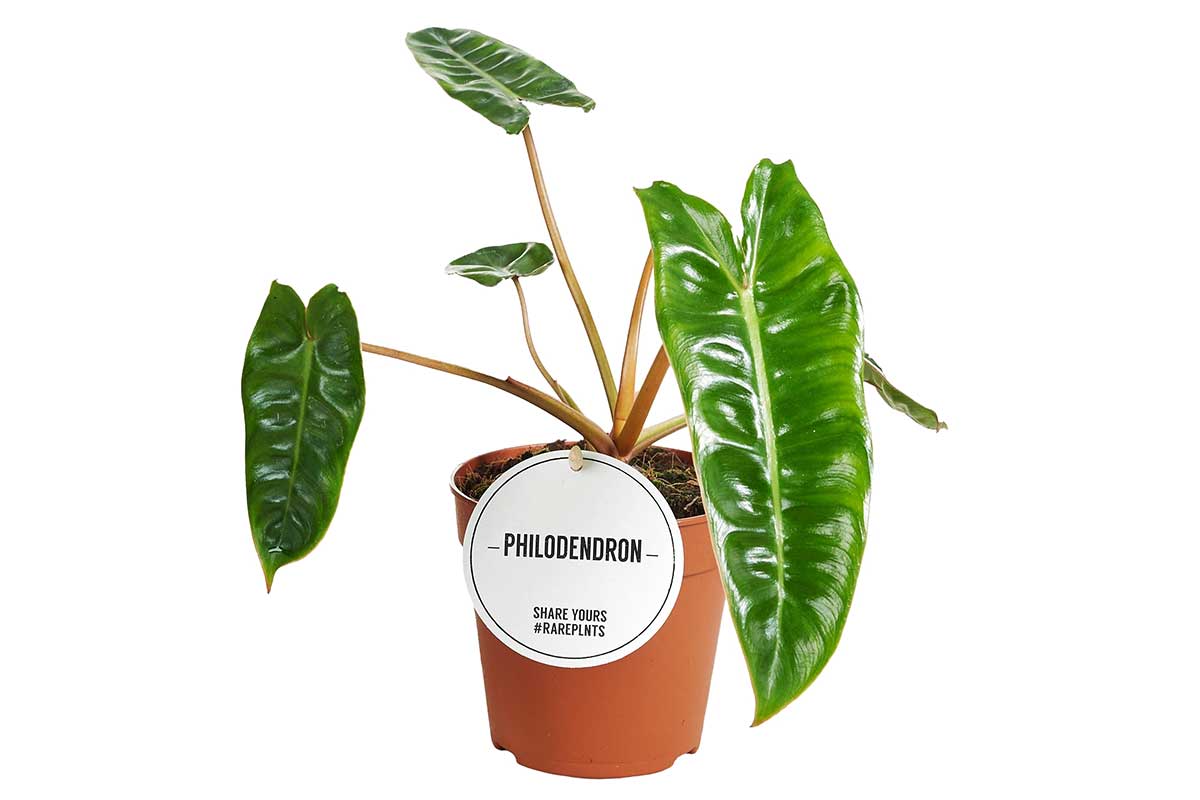
An orange petiole
The petiole acts as a separate colour column and stays visible even when blades overlap.
This store requires javascript to be enabled for some features to work correctly.
If you cannot pronounce it, we are not giving it to you 😎
Family: Araceae · Pot diameter: 12 cm · Height: 25 cm
Philodendron billietiae combines very long narrow green blades with vivid orange-to-copper petioles. The warm upright line of each petiole remains visible beneath the leaf, making the silhouette recognisable even before it matures.
The juvenile silhouette of Philodendron billietiae stays clean and flexible, while successive nodes gradually reveal larger, more mature leaves as the stem climbs.
Its contrast comes not from variegation but from the cool green blade against a consistently warm-toned petiole.
The petiole acts as a separate colour column and stays visible even when blades overlap.
The narrow blade projects strongly forward and often develops a gentle movement along the margin.
The climbing stem organises long petioles better when anchored to a stable vertical surface.
Why you’ll love it: it adds warm orange colour without flowers and develops impressive scale on support.
Near a bright window with a slim support or moss pole so the nodes can climb and the leaves can mature. Leave breathing room around the crown so each leaf shape reads clearly.
Choices with compatible light needs and contrasting textures keep the arrangement balanced.
Bright, indirect light. Variegated forms need steady light without harsh sun.
When the top 2–4 cm are dry. Water thoroughly and let all excess drain away.
Moderate to higher humidity and roughly 18–29°C, away from cold or hot draughts.
Not safe to chew. It contains insoluble calcium oxalate crystals.
Keep it near an east-facing or bright north-facing window, or behind a sheer curtain. Low light reduces leaf size and variegation, while harsh sun can scorch pale tissue.
Check the mix before every watering and wait until the top 2–4 cm are dry. Water evenly, let it drain and never leave water standing in the cover pot.
It adapts to average household humidity, but steady humidity and gentle air movement support cleaner edges and smoother unfurling.
An ideal range is roughly 18–29°C. Avoid cold glass, air-conditioner draughts and sudden changes that slow growth.
Use an airy aroid mix with ample pore space around the roots and moderate moisture retention. Unrestricted drainage is essential.
During active growth, use a balanced liquid feed at the label rate and only on already moist substrate. Repot when roots fill the pot, moving up by one size.
Philodendron billietiae is an accepted species in Araceae. It was described by Thomas B. Croat and published in 1995.
The name billietiae belongs to the species itself. Its orange petiole colour is a plant characteristic, not an added trade designation.
Its native range includes French Guiana, Guyana and Pará in Brazil, in wet tropical rainforest.
The orange axis joins blade to node but carries no nodes of its own. Propagation requires part of the true stem, not merely a petiole and leaf.
Near the blade is a flexible zone, the geniculum, which helps the leaf adjust its angle to light without twisting the whole stem.
With attachment and sufficient resources, successive blades can greatly extend their long axis. This is developmental maturation, not low-light stretching.
Insoluble needle-shaped calcium oxalate crystals occur in the tissues. Ingestion may cause pain, swelling and drooling.
Practical answers about growth and the plant’s most common signals.
Intensity varies with tissue age, genetic expression and light. Provide steady bright indirect light and assess mature petioles across more than one leaf.
One old lower leaf may be ageing normally. Several yellow leaves at once call for a check of moisture, drainage, light and roots before adding water or fertiliser.
Climbing forms benefit from a firm pole or moss surface, while self-heading rosettes mainly need room. Tie only the stem, never a leaf petiole.
Low or abruptly changing humidity, a dry root zone or cold can hinder unfurling. Stabilise conditions and never pull a soft blade from its sheath.
On climbing forms, cut a healthy section with at least one node and a viable growth point. Self-heading forms will not propagate from a plain leaf without a node.
Not for chewing or ingestion. Insoluble calcium oxalate raphides can cause severe oral irritation. Keep it out of reach and seek professional advice if ingestion or symptoms occur.