

Watermelon-rind pattern
Silver bands follow the main veins and alternate with deeper green, creating an instantly recognisable surface.
This store requires javascript to be enabled for some features to work correctly.
Watermelon Peperomia 🍉
Family: Piperaceae · Pot diameter: 12 cm · Height: 20–25 cm
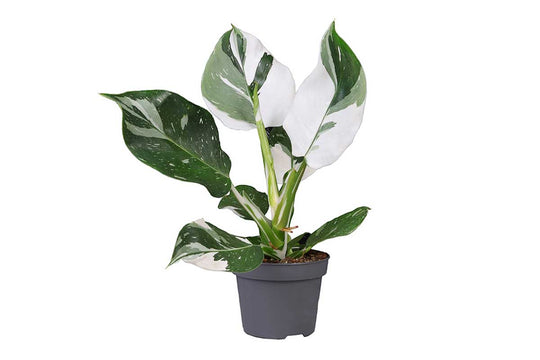
Peperomia argyraea is the classic watermelon peperomia, with round leaves striped in silver and deep green like a watermelon rind. Reddish petioles lift each blade above the pot like a small shield.
Up close, reflections, veins and small leaf-to-leaf differences give Peperomia argyraea far more detail than its compact silhouette first suggests.
Its appearance rests on three clear elements: a round outline, radial venation and metallic contrast.
Silver bands follow the main veins and alternate with deeper green, creating an instantly recognisable surface.
The petiole joins the lower surface inward from the margin and holds the nearly circular leaf horizontally.
Warm petiole tones form fine contrasting lines between the pot and cool silver-green foliage.
Why you’ll love it: it brings one of the most recognisable leaf patterns into a size that fits almost anywhere.
On a bright shelf, desk or small side table near a window but away from harsh midday sun. A matte pot in terracotta, cream or deep green lets the foliage take the lead.
Choices with compatible light needs and contrasting textures keep the arrangement balanced.
Bright, indirect light. Gentle morning sun is usually fine, but harsh midday sun is not.
When the upper third to half of the substrate is dry. Water thoroughly, then let it drain completely.
Average household humidity and 18–27°C. Protect it from cold draughts and temperatures below 15°C.
Generally considered non-toxic to cats and dogs, although it is not intended for chewing.
Provide plentiful filtered light for compact growth and clear colour. Low light stretches the stems, while strong direct sun can bleach or mark the leaves.
Check with a finger or by the pot’s weight and water only after the upper layer is clearly dry. Empty the cover pot every time; the fleshy tissues handle a short delay better than constant wetness.
Normal household humidity is adequate when watering is consistent. Avoid keeping the foliage continuously wet and provide gentle air movement.
Keep it in a stable, warm room, ideally 18–27°C. Cold glass, winter draughts and sudden temperature drops can cause spotting or leaf loss.
Use a fine yet airy mix that drains quickly and does not compact around the fine roots. Drainage holes are essential.
Feed lightly only during active growth, following the label rate. Repot when roots fill the pot and move up by one size only; an oversized pot stays wet for longer.
The currently accepted spelling is Peperomia argyraea W.Bull. The widely used form P. argyreia is treated as a synonym.
The name was published in 1865 and refers to the foliage’s silvery colour. “Watermelon” is a descriptive common name, not a botanical rank.
The species is native to the Brazilian states of Bahia, Rio de Janeiro and São Paulo, where it occurs in wet tropical settings as a subshrub or epiphyte.
Silver and green are arranged radially around the petiole attachment, highlighting the paths of the main veins.
The bright appearance does not mean chlorophyll-free white tissue. Surface structure and reflection change how the green is perceived.
A petiole attached nearer the centre lets the main veins spread radially and support the broad blade.
The species can grow epiphytically in organic material with ample air. In a pot, that translates to an airy mix and no constant saturation.
Practical answers about growth and the plant’s most common signals.
Common causes include low light, prolonged dryness, exhausted substrate or restricted roots. Correct light and watering first, then consider gentle feeding or repotting during active growth.
When the upper third to half of the mix is dry and the pot feels noticeably lighter. Water evenly, let it drain and never leave water standing in the cover pot.
They often point to excess moisture or a poorly oxygenated root zone. Pause watering, check drainage and roots, and remove only tissue that has actually rotted.
No. Fine roots perform well in a relatively snug pot. Repot during active growth when roots have genuinely filled the container, moving up by one size only.
Use a healthy stem section containing a node and, in several species, a leaf or leaf section. Work with a clean tool, an airy medium and gentle moisture without saturation.
Peperomia species are generally considered non-toxic to cats and dogs. Chewing can still cause mechanical irritation or stomach upset, so keep the plant away from persistent pets.