

Chartreuse across the blade
Yellow-green colour covers the leaf and becomes especially vivid in correct bright indirect light.
This store requires javascript to be enabled for some features to work correctly.
The plant that politely declined low-brightness mode
Family: Araceae · Pot diameter: 12 cm · Height: approx. 15 cm
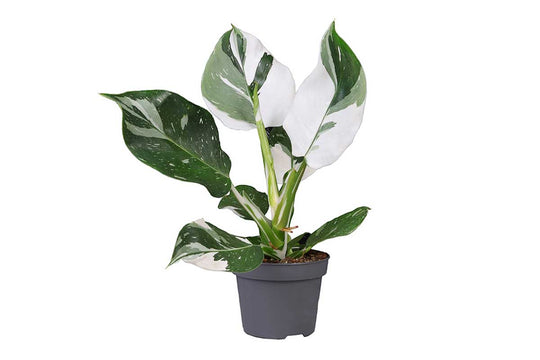
Epipremnum aureum ‘Neon’ fills a space with almost electric yellow-green foliage, luminous from the young tip to mature heart-shaped blades.
Its clean single-colour palette works like a line of light among darker plants and holds interest without white variegation.
Strong pigment, simple geometry and quick climbing movement turn Neon into a natural source of visual light.
Yellow-green colour covers the leaf and becomes especially vivid in correct bright indirect light.
Young growth often opens exceptionally bright and deepens slightly with maturity.
Its impact comes not from spotting but from one clean, continuous field of colour.
Why you will love it: it adds instant brightness and strong design contrast while remaining one of the most cooperative climbing plants.
Let it trail from a high shelf or guide it up a slim support near a bright window without hot sun. Matte white, charcoal, terracotta or deep-green planters keep the foliage in the leading role.
Pair it with aroids of contrasting texture so its palette stands out within a coherent, easy-care composition.
Bright indirect light. Medium light is tolerated, but pattern and compact growth improve close to a bright window.
Water when the top 2–4 cm dries, soaking evenly and allowing all excess water to escape.
Keep at 18–28°C with average to moderate humidity and protection below 15°C.
Not pet-safe. Aroid tissues contain irritating insoluble calcium oxalate crystals.
Provide bright indirect light near an east-facing or filtered south-facing window. Deep shade reduces pace and contrast, while hot direct sun may fade or scorch the blades.
Check the mix 2–4 cm down and water once that layer has dried. Wet the whole root ball and drain fully without leaving water in the decorative outer pot.
Normal household humidity is sufficient, although stable moderate humidity helps new leaves open cleanly. Wipe dust gently rather than relying on repeated misting.
Keep it ideally at 18–28°C and away from cold draughts. Water use falls in lower light, so the winter watering rhythm should slow accordingly.
Use a chunky, airy aroid mix in a pot with unrestricted drainage. It may trail or climb; on a support, mature leaves usually increase in size.
HB-101 is a plant biostimulant/vitalizer, not a complete NPK fertilizer. Use it as a complementary product at the label rate for gentle support after stress or repotting. It does not replace balanced base nutrition during active growth.
Epipremnum aureum is an accepted climbing species in the Araceae. ‘Neon’ is a cultivated selection, not a separate wild species.
The documented native range of the species is Mo’orea in the Society Islands. Its present global distribution is largely the result of cultivation and introduction.
Older literature used combinations including Pothos aureus and Scindapsus aureus. The accepted modern name is Epipremnum aureum.
Roots form at nodes to anchor the stem to a support and absorb moisture. They do not automatically mean the plant needs a larger pot.
With a stable support, good light and time, successive leaves can enlarge and develop more pronounced morphology than juvenile foliage.
The luminous yellow-green colour reflects a different pigment balance, not a complete absence of chlorophyll. The leaves remain photosynthetically active.
Araceae tissues contain microscopic calcium oxalate crystals. Chewing releases these raphides and causes immediate irritation.
Practical answers about behaviour, common signs and correct care for this plant.
In lower light it often produces more chlorophyll and the shade deepens. Move it gradually into brighter indirect light and judge the next leaves.
Check the top 2–4 cm and the pot's weight. If the upper layer is dry and the pot lighter, water deeply and drain; if it remains cool and moist, wait.
Not by itself. Chartreuse is a cultivar trait. Suspect a nutrition problem only when it comes with weak growth, uneven chlorosis or root trouble.
One old lower leaf can yellow naturally. Several at once, especially with constantly wet mix, call for a check of watering, drainage, light and roots.
Both forms are valid. Trailing creates long lines, while a stable support encourages upward growth and can produce larger, more mature leaves.
Not for chewing or ingestion. Insoluble calcium oxalate crystals can cause oral pain, drooling and difficulty swallowing. Keep it out of reach and contact a vet or doctor if exposure occurs.