
Form
Stems curve and trail while turned leaves create a dense irregular mass.
This store requires javascript to be enabled for some features to work correctly.
The plant with better curls than any of us🌺
Family: Gesneriaceae · Pot diameter: 15 cm · Height: 40–45 cm
Aeschynanthus radicans ‘Twister’ turns foliage into movement: every glossy leaf twists around the stem and the dense trailing crown resembles an endless green curl. When red tubular flowers appear, they emerge through the spirals like bright brushstrokes. In a hanging position or on a high piece of furniture it creates a dramatic theatrical silhouette that fills the room without needing perfect symmetry.
‘Twister’ is for anyone wanting more than an ordinary trailing plant. Its twisted texture looks sculptural even without flowers, while the contrast between deep green and red adds a seasonal burst of colour to a collectable display.
‘Twister’ multiplies visual volume through spirals, dense branching and vivid flowers.
Stems curve and trail while turned leaves create a dense irregular mass.
Deep glossy green provides a backdrop for red to orange-red tubular blooms.
The glossy fleshy surface reflects light in a different direction on every twist.
Why you’ll love it: it delivers constant movement and sculptural volume, with red flowers appearing like small flames through the crown.
On a high shelf or in a hanging pot where the stems can fall freely and receive even light. A small turn every few weeks keeps the silhouette balanced.
Choices with compatible light needs and contrasting textures keep the arrangement balanced.
Bright filtered light; a little gentle morning sun supports flowering.
Water when the upper portion dries, wetting evenly and allowing complete drainage.
Moderate to higher humidity, gentle airflow and roughly 18–27°C.
It is not generally listed as markedly toxic, but it is not food and chewing should be discouraged.
Place it in plentiful bright filtered light. Gentle morning sun can help, while harsh midday sun marks the foliage.
Let the upper portion dry, water the whole root zone and allow immediate drainage. Deep drying and permanent saturation can both trigger leaf drop.
Aim for moderate to higher humidity without stagnant air. Do not keep the dense twisted foliage continuously wet.
Maintain roughly 18–27°C and protect it from cold draughts or heaters. Abrupt changes can cause buds to drop.
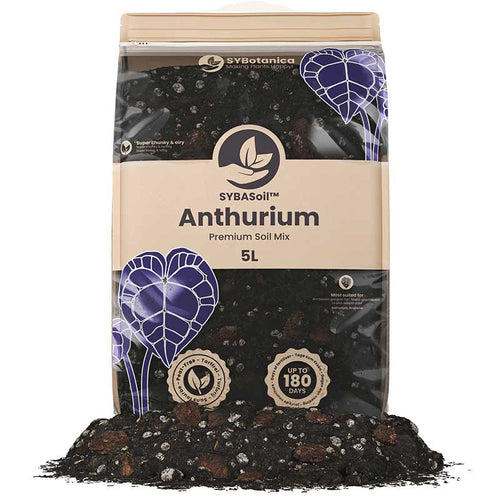
Anthurium mix provides bark and air pockets suited to epiphytic roots. Keep the plant at the same depth when repotting.
Use Nutri One according to the label during active growth, on already moist mix. Avoid feeding when the plant is dry or stressed.
Aeschynanthus radicans is native from southern Myanmar to western and central Malesia.
In nature it grows as an epiphyte or lithophyte in wet tropical forest, with stems hanging from branches and rocks.
‘Twister’ is a cultivated selection for strongly twisted foliage. A specific originator or formal registration is not publicly documented.
From natural habitat to care: Its epiphytic origin explains the need for an airy root zone, gentle steady moisture and free circulation around the dense crown.
Uneven tissue growth around the blade creates curves that reflect light in many directions.
The elongated corolla forms a tube, a shape associated with specialised pollinators in tropical forest.
Thicker leaves buffer brief dry periods without making the plant a drought succulent.
In nature the roots anchor into porous organic material above ground with continual access to air.
Practical answers about growth and the plant’s most common signals.
The degree of twisting varies naturally by leaf and stage of growth. Steady light and stable conditions help new growth retain its characteristic rhythm.
Check for an abrupt move, deep drying, mix that stays wet or a cold draught. Correct the cause first and do not add water automatically.
Provide plentiful filtered light, stable conditions and moderate feeding in growth. A slightly cooler bright period can help initiate buds.
Yes, after flowering or during active growth. Cut just above a node to encourage branching and use a clean tool.
When roots have filled the pot or the mix has lost its porous structure. Move up one size and do not bury the base more deeply.
Aeschynanthus species are not generally listed as markedly toxic, but they are not food. Discourage repeated chewing and consult a vet if symptoms appear.
