






This store requires javascript to be enabled for some features to work correctly.
 THE LIVING GALLERY
The legal guarantee concerns the plant’s conformity at delivery. It is not a guarantee of survival or growth for two years. Each issue is assessed taking into account the nature of the plant, its care and the conditions in which it is kept. Your statutory rights remain unaffected.
The plant with better curls than any of us🌺
Aeschynanthus ‘Twister’ turns foliage into movement: every glossy leaf twists around the stem and the dense trailing crown resembles an endless green curl. When red tubular flowers appear, they emerge through the spirals like bright brushstrokes. In a hanging position or on a high piece of furniture it creates a dramatic theatrical silhouette that fills the room without needing perfect symmetry.
‘Twister’ is for anyone wanting more than an ordinary trailing plant. Its twisted texture looks sculptural even without flowers, while the contrast between deep green and red adds a seasonal burst of colour to a collectable display.
‘Twister’ multiplies visual volume through spirals, dense branching and vivid flowers.
Stems curve and trail while turned leaves create a dense irregular mass.
Deep glossy green provides a backdrop for red to orange-red tubular blooms.
The glossy fleshy surface reflects light in a different direction on every twist.
Why you’ll love it: it delivers constant movement and sculptural volume, with red flowers appearing like small flames through the crown.
On a high shelf or in a hanging pot where the stems can fall freely and receive even light. A small turn every few weeks keeps the silhouette balanced.
Choices with compatible light needs and contrasting textures keep the arrangement balanced.
Bright filtered light; a little gentle morning sun supports flowering.
Water when the upper portion dries, wetting evenly and allowing complete drainage.
Moderate to higher humidity, gentle airflow and roughly 18–27°C.
Best kept away from pets as a precaution. Prevent access and chewing.
Place it in plentiful bright filtered light. Gentle morning sun can help, while harsh midday sun marks the foliage.
Let the upper portion dry, water the whole root zone and allow immediate drainage. Deep drying and permanent saturation can both trigger leaf drop.
Aim for moderate to higher humidity without stagnant air. Do not keep the dense twisted foliage continuously wet.
Maintain roughly 18–27°C and protect it from cold draughts or heaters. Abrupt changes can cause buds to drop.
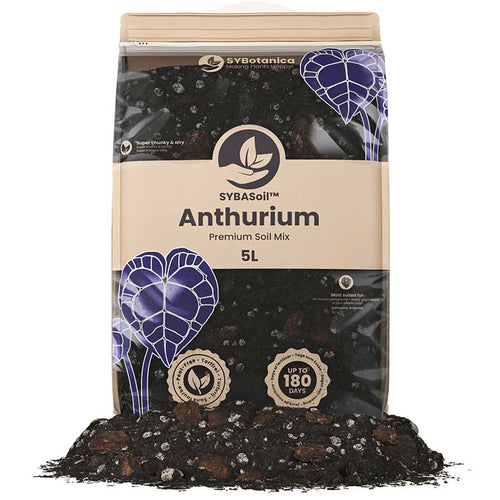
Anthurium mix provides bark and air pockets suited to epiphytic roots. Keep the plant at the same depth when repotting.
Use a balanced liquid houseplant fertiliser about once a month at half the recommended strength during active spring and summer growth. Apply to an already slightly moist substrate. Reduce or stop feeding as growth slows, and do not feed a dry or stressed plant.
Aeschynanthus ‘Twister’ is a cultivated variety in the Gesneriaceae family, known for its curled foliage.
Albert Schouten selected a branch mutation of ‘Rasta’ in Sleeuwijk, the Netherlands, in May 2003. Patent PP17916 followed in 2007.
Wild Aeschynanthus species range from southern China to tropical Asia. This region differs from the Dutch location where ‘Twister’ was selected.
Leaves curve backwards and form a hollow; ‘Rasta’ leaves are reflexed but flat.
The upper surface is smooth; fine hairs cover the underside and leaf margins.
Five fused petals form the red corolla. The dark calyx consists of sepals.
Cuttings preserve cultivar traits, while light and temperature influence the plant’s appearance.
Practical answers about growth and the plant’s most common signals.
The degree of twisting varies naturally by leaf and stage of growth. Steady light and stable conditions help new growth retain its characteristic rhythm.
Check for an abrupt move, deep drying, mix that stays wet or a cold draught. Correct the cause first and do not add water automatically.
Provide plentiful filtered light, stable conditions and moderate feeding in growth. A slightly cooler bright period can help initiate buds.
Yes, after flowering or during active growth. Cut just above a node to encourage branching and use a clean tool.
When roots have filled the pot or the mix has lost its porous structure. Move up one size and do not bury the base more deeply.
For this particular plant, we recommend keeping it away from cats and dogs as a precaution. This does not classify the plant as toxic. It is not intended for consumption; prevent access and chewing.
Every order is prepared with care so your plant arrives upright, secure and safe.
Individual protection
Plants in pots with a capacity of 3 litres or more are placed in individual boxes that hold the pot securely and reduce the risk of tipping over.
Sturdy packaging
We use reinforced cardboard designed to protect against impacts and vibration during transport.