






This store requires javascript to be enabled for some features to work correctly.
 THE LIVING GALLERY
The legal guarantee concerns the plant’s conformity at delivery. It is not a guarantee of survival or growth for two years. Each issue is assessed taking into account the nature of the plant, its care and the conditions in which it is kept. Your statutory rights remain unaffected.
Because an ordinary Aeschynanthus was far too… straight 🫠
Aeschynanthus radicans ‘Rasta’ forms a dense green trail of tightly curved glossy leaves resembling small braids. Repeated curls give the crown intense depth, rich volume and a distinctly sculptural character, while red tubular flowers appear between the curves like vivid brushstrokes. On a high shelf or in a hanging position it becomes an immediate focal feature that remains impressive even out of bloom.
‘Rasta’ has a more organised compact curl than an ordinary lipstick plant, making it look hand-designed. It works beautifully against a calm background where the texture can be seen clearly and red flowers gain real intensity.
‘Rasta’ stands out for denser repeating curls and a lush trailing mass.
Stems fall in compact lines, covered by leaves curving towards the axis.
Deep green dominates year-round, with red flowers adding vivid seasonal contrast.
The smooth glossy surface and continuous curves create layers of light and shade.
Why you’ll love it: it remains sculptural and full even without flowers, while red blooms elevate the dense green trail.
On a high shelf or in a hanging pot where the stems can fall freely and receive even light. A small turn every few weeks keeps the silhouette balanced.
Choices with compatible light needs and contrasting textures keep the arrangement balanced.
Bright filtered light; a little gentle morning sun supports flowering.
Water when the upper portion dries, wetting evenly and allowing complete drainage.
Moderate to higher humidity, gentle airflow and roughly 18–27°C.
It is not generally listed as markedly toxic, but it is not food and chewing should be discouraged.
Place it in plentiful bright filtered light. Gentle morning sun can help, while harsh midday sun marks the foliage.
Let the upper portion dry, water the whole root zone and allow immediate drainage. Deep drying and permanent saturation can both trigger leaf drop.
Aim for moderate to higher humidity without stagnant air. Do not keep the dense twisted foliage continuously wet.
Maintain roughly 18–27°C and protect it from cold draughts or heaters. Abrupt changes can cause buds to drop.
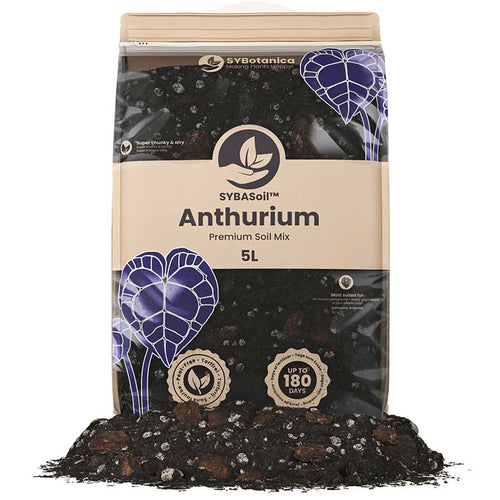
Anthurium mix provides bark and air pockets suited to epiphytic roots. Keep the plant at the same depth when repotting.
Use Nutri One according to the label during active growth, on already moist mix. Avoid feeding when the plant is dry or stressed.
Aeschynanthus radicans is native from southern Myanmar to western and central Malesia.
It is an epiphyte or lithophyte of wet tropical forest, where stems hang from branches and rocky surfaces.
‘Rasta’ is a cultivated selection for densely curled foliage. The name is horticultural, and a specific formal origin is not publicly documented.
From natural habitat to care: Its epiphytic origin explains why the dense crown needs air and the roots require porous mix that holds gentle moisture without permanent saturation.
Different rates of elongation on the two sides of the blade force the leaf to curve towards the axis.
The corolla emerges from a darker calyx, creating the lipstick effect behind the English common name.
Thicker tissue stores a small amount of water but does not protect against prolonged drought.
Natural roots anchor into organic debris above ground, where drainage is immediate.
Practical answers about growth and the plant’s most common signals.
Both have curved foliage, but ‘Rasta’ is generally presented with a tighter denser repetition of leaves. Actual form naturally varies by plant.
Check for an abrupt move, deep drying, mix that stays wet or a cold draught. Correct the cause first and do not add water automatically.
Provide plentiful filtered light, stable conditions and moderate feeding in growth. A slightly cooler bright period can help initiate buds.
Yes, after flowering or during active growth. Cut just above a node to encourage branching and use a clean tool.
When roots have filled the pot or the mix has lost its porous structure. Move up one size and do not bury the base more deeply.
Aeschynanthus species are not generally listed as markedly toxic, but they are not food. Discourage repeated chewing and consult a vet if symptoms appear.
Every order is prepared with care so your plant arrives upright, secure and safe.
Individual protection
Plants in pots with a capacity of 3 litres or more are placed in individual boxes that hold the pot securely and reduce the risk of tipping over.
Sturdy packaging
We use reinforced cardboard designed to protect against impacts and vibration during transport.