

An outline without a template
The green does not form a uniform frame: sometimes it becomes a fine line, while elsewhere it spreads across larger areas of the leaf blade.
This store requires javascript to be enabled for some features to work correctly.
Green has taken a back seat ✨
Family: Araceae · Pot diameter: 12 cm · Height: 30 cm
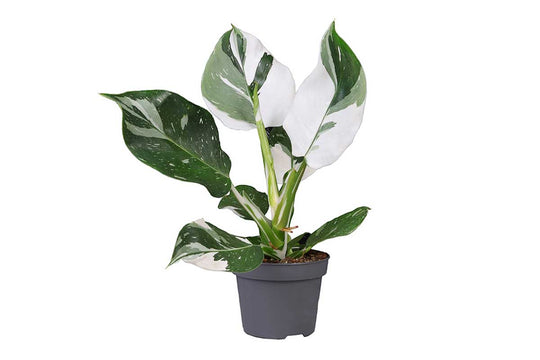
Aglaonema 'Gold' changes the balance of classic green foliage: cream and golden-yellow areas take the leading role, while deeper green remains along the edges and in irregular brushstrokes. Its elongated leaves taper to fine points and open in different directions, like small, luminous blades with painted outlines.
Pale leaf stalks carry the soft palette down into the plant, where overlapping leaves create a full, layered silhouette. Against dark wood or beside matt ceramics, its warm shades stand out without bold flowers or dramatic bursts of colour. This is an aglaonema that draws the eye through subtle differences from leaf to leaf.
The detail lies both in the colour and in the way the foliage is arranged.
The green does not form a uniform frame: sometimes it becomes a fine line, while elsewhere it spreads across larger areas of the leaf blade.
Pale leaf stalks allow the light palette to continue between the leaves, rather than ending at their surface.
Upright, bushy growth combines younger leaves near the centre with a broader spread around the outside, adding depth to the silhouette.
Why you’ll love it: it brings the warmth of gold to a living composition that changes with every new leaf.
On a desk or side table near a window with diffused light, with space around it to appreciate the spread of its leaves. A plain cachepot in charcoal, deep green or warm white highlights its palette.
Pair it with plants that appreciate warmth and indirect light. Keep each plant in a separate pot so that watering can follow its individual needs.
Bright indirect light, without strong direct sun. Avoid dark corners.
When the top 2–3 cm of the mix have dried. Water thoroughly and allow to drain.
A warm environment, around 18–27°C, without cold draughts. Prefers moderate to higher humidity.
Toxic if chewed or swallowed. Keep away from pets and small children.
Place near a window with filtered light, protected from strong midday and afternoon sun. The pale areas need gentle illumination, without sudden exposure to strong sunshine.
Let the top 2–3 cm dry before watering again, without leaving the entire root ball dry for prolonged periods. Use room-temperature water and empty the saucer or cachepot. Intervals usually become longer in winter.
It tolerates normal household humidity but appreciates more stable, moderate to higher humidity. Avoid dry air from radiators and air conditioning. Gently clean leaves with a damp cloth without keeping them constantly wet.
Aim for around 18–27°C and protect from temperatures below 15°C, cold window glass and draughts. Aglaonemas can suffer chilling damage even without frost.
It needs an organic, airy aroid mix that retains some moisture but drains freely. The pot must have drainage holes. Avoid compacted soil and water permanently sitting around the roots.
During active growth, usually spring–summer, use a balanced liquid houseplant fertiliser about every four weeks, at the lower rate stated on its label. Stop when growth slows. If fresh growing medium contains fertiliser, wait for the period specified on the packaging before adding more. Repot when roots fill the pot, choosing a slightly larger container.
It belongs to the Araceae family. Aglaonemas are perennial plants with stalked leaves and characteristic inflorescences consisting of a spathe and spadix.
Aglaonema 'Gold' is a cultivated selection with pale, green and golden-yellow foliage. Its exact parentage and breeder remain unknown.
Wild species of the genus occur from northeastern India to Papua New Guinea. This is the geographical origin of the genus, not the place where ‘Gold’ was developed.
In Aglaonema, female flowers occupy the lower part of the spadix and male flowers sit above them. The female flowers become receptive before pollen is released by the same inflorescence: this protogyny limits self-pollination.
Chlorophylls, carotenoids and, in certain cultivars, anthocyanins contribute to the aglaonema palette. Their relative amounts change the visible result; leaf colour alone does not measure photosynthetic performance.
Chilling stress in aglaonemas can cause dark, water-soaked patches without the tissue freezing. Sensitivity differs markedly between cultivars, so the tolerance of one selection cannot automatically be applied to another.
The tissues contain insoluble calcium oxalate crystals. Chewing damages the cells surrounding them and brings the crystals into contact with mucous membranes, causing pain and irritation.
Golden colour, new leaves and the signs worth watching.
The cream and golden-yellow areas are a feature of ‘Gold’. A leaf that suddenly changes colour, softens or develops spots is a different matter. Check light, watering and temperature before adding fertiliser.
It is not a good choice for deep shade. Choose bright indirect light for this pale-leaved selection. The general tolerance of some green aglaonemas to low light does not mean all cultivars perform equally.
The proportions of green, cream and yellow vary naturally. Observe successive leaves as they mature, without trying to force identical colour through extra fertiliser or sudden exposure to sunshine.
Check whether the mix stays too wet or water collects in the cachepot. Excessive watering and cold can cause serious stress. Do not automatically water because the foliage droops; inspect the roots and drainage first.
It may produce discreet inflorescences with a pale spathe surrounding the spadix. Flowering is not guaranteed indoors, and its absence does not indicate a problem. The foliage remains its main decorative feature.
Not for chewing or swallowing. Calcium oxalate crystals cause mouth irritation, drooling and possible difficulty swallowing. Keep it out of reach and contact a vet if your pet chews the plant.
Every order is prepared with care so your plant arrives upright, secure and safe.
Individual protection
Plants in pots with a capacity of 3 litres or more are placed in individual boxes that hold the pot securely and reduce the risk of tipping over.
Sturdy packaging
We use reinforced cardboard designed to protect against impacts and vibration during transport.