

Substantial three-lobed leaves
The leaves reach about 4 × 4 cm and have three broad lobes rather than the narrow points of other cultivars. Their form reads clearly even from a short distance.
This store requires javascript to be enabled for some features to work correctly.
Small, dense and visibly proud of its outline 🌿
Family: Araliaceae · Pot diameter: 8.5 cm · Height: 10 cm
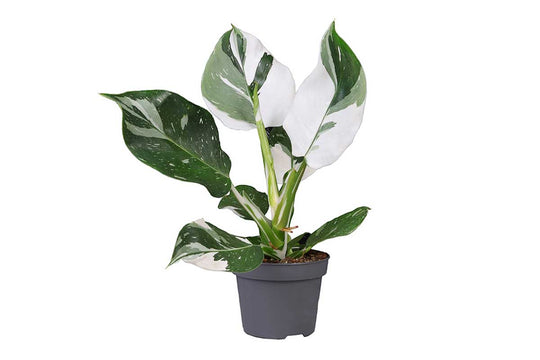
The Hedera ‘White Wonder’ is small in scale but exceptionally generous in pattern. Its compact, three-lobed leaves combine grey-green and green markings with a broad, clean cream-white margin that instantly brightens the whole plant. Short upright shoots fill its centre, while longer ones flow outwards to form a dense, carefully finished outline. It is the effortless detail that makes a planting composition look complete at first glance.
At the edge of a pot, in a window box or as a low border, it becomes an evergreen white ribbon. It does not need to grow into a large climber to make an impression: the contrast stays close to eye level, where the individual markings and the leaves' consistent, soft geometry can be appreciated.
The cultivar balances two kinds of shoot — short ones that fill the centre and longer ones that spread — with the exceptionally broad white margin of the ‘Wonder’ form.
The leaves reach about 4 × 4 cm and have three broad lobes rather than the narrow points of other cultivars. Their form reads clearly even from a short distance.
The grey-green centre meets a broad cream-white edge with an irregular inner line. Its proportions vary naturally on every new leaf, creating variety without losing visual coherence.
Short shoots rise slightly and fill the top, while stiffer, longer stems extend horizontally or trail. This dual architecture makes it ideal for finishing the edge of a planting composition.
Why you will love it: creates the clean, luminous look of a green-and-white cushion while allowing a few stems to spill gracefully over the edge.
Use it at the front of a shaded window box, in a raised bed or as a low mass among stones. In a low planting it forms a band about 8–15 cm high and 25–36 cm across. In partial shade, the pale areas remain clear without being scorched by strong afternoon light.
Set off the white margin with deep purple, glossy green and small winter-pink accents. Keep companion plants low so they do not hide the trailing line.
Bright shade or gentle partial shade. A little morning sun is beneficial, but the white margins need protection during the hottest hours.
Let the surface begin to dry, then water evenly. Avoid both prolonged dryness and water remaining around the roots.
More sensitive to severe cold than many green ivies; choose a sheltered position and protect the small pot when prolonged frost is forecast.
Not edible. Ingestion may be harmful and the sap may irritate sensitive skin; wear gloves and keep it out of animals' reach.
Prioritise an edge, front row or hanging position. The longer stems need clear space to descend without being pressed between taller plants.
Use a loose, humus-rich mix that retains a little moisture but drains promptly. In an outdoor pot, check that drainage holes are not blocked by roots or by a saucer holding water.
Move it up by only one pot size when the roots have genuinely filled the current pot. An excessive volume of fresh mix dries slowly and increases the risk of rot.
Check the soil rather than the calendar. In hot air it will need more frequent checking, while in winter the small foliage uses less water.
If growth is healthy, a dilute balanced feed in spring and early summer is sufficient. Stop when temperatures fall or the soil remains moist for several days.
Cut a long bare stem just above a node to activate lateral buds. Do not level the whole plant to one length; retain a few trailing lines for a natural outline.
Remove entirely green shoots at their base. Green tissue contains more chlorophyll and can quickly outgrow the slower white-variegated growth.
Avoid a hot, enclosed spot that favours spider mites. Good airflow and a gentle rinse of the foliage help, provided it dries before nightfall.
The young plant first builds short branches close to the base. Each light pinch activates lateral buds and makes the green-and-white cushion denser.
Selected stems then lengthen and pass over the edge. The cultivar looks best when these stems are kept at different lengths rather than cut into a perfectly straight line.
With consistent light and correct moisture, the centre remains compact while the perimeter expands. If it finds a surface it may begin to cling, although its most characteristic use remains low or trailing.
Indicative scale for pruned seasonal use: a low, dense centre with selected stiff stems spreading or descending over the edge.
As an evergreen cultivar it retains its leaves. The meaningful change is developmental: a compact centre becomes a dense upper layer with longer trailing lines.
What to expect after planting: the first visible change will be small new tips in the centre, followed by longer outer lines. The proportion of white differs from leaf to leaf and is not, by itself, a sign of instability.
The Hedera helix ‘White Wonder’ appeared in Denmark around 1980 as a variegated form of the green Hedera helix ‘Wonder’. It retained the compact, rounded three-lobed leaf of the original form, but gained grey-green markings and a much broader cream-white margin.
Danish records from the 1980s do not name the first selector or the nursery that recognised it. The story we can document begins in Danish cultivation during that decade and continues through this readily identifiable combination: a dense centre, longer stiff shoots and a broad white edge.
The white part of the leaf is not a surface coating. Its cells contain much less chlorophyll, or plastids that did not develop into fully green chloroplasts, while the green centre performs most of the photosynthesis.
When a creeping stem remains in contact with moist soil, its nodes can form ordinary adventitious roots and establish a new point of support. In vertical contact, smaller aerial rootlets specialise mainly in adhesion.
In its juvenile phase ivy creeps or climbs, bears lobed leaves and forms roots. Its mature phase becomes shrubby, stops clinging and produces unlobed leaves and flowers — a developmental shift controlled by networks such as the miR156/SPL axis.
What you need to know about its low habit, white margin, watering and outdoor use.
It can be grown in either setting. Outdoors, choose sheltered shade or partial shade; indoors, it needs a cool, bright position without direct hot sun and away from heating appliances.
In low seasonal use it can be maintained at about 8–15 cm high and 25–36 cm across. If left for years and allowed to find a surface, its stems can extend farther, but they are easily controlled by pruning.
Variegation varies naturally, particularly with light. If an entire shoot becomes uniformly green, however, remove it at the base so it does not become dominant.
The species is adaptable, but this cultivar's broad white margins scorch more readily in intense Mediterranean sun. Morning light or bright shade is safer.
Selectively shorten the longest tips just above a node and provide sufficient gentle light. New branching will fill the centre without entirely losing the trailing line.
No. Ivy is harmful if eaten and may irritate the skin. Hang it or place it where animals and children cannot reach it.